 How-to
How to Find Reliable Trucks for Pallet Delivery
Quick Summary
Reliable pallet delivery starts with three numbers: pallet count, total loaded weight and dimensions per pallet. Confirm those in writing, match them to a truck with the right payload, tray length and tail-lift if there is no forklift, then verify the carrier's insurance, load restraint and claims process before booking.
- Record pallet count, pallet type, total loaded weight, and length, width and height per pallet.
- Confirm the rated payload of the specific vehicle the carrier will send, not just the class.
- Request a tail-lift vehicle if the drop-off site has no dock or forklift.
- Ask for a current certificate of currency and confirm goods in transit cover meets your load value.
- Compare quotes line by line, checking what is excluded such as tail-lift use, waiting time and tolls.
Table of Contents
- Start With Your Pallet Load: Count, Weight and Dimensions
- Truck Capacity for Pallets: Matching Vehicle Type to Load
- How to Verify a Carrier Before You Book
- Pallet Transport Quotes: Comparing Like With Like
- Pallet Delivery Checklist Before Dispatch
- Tracking Your Pallet Delivery From Pickup to Drop-Off
- Booking Your Next Pallet Load With NextLoad Australia
- Frequently Asked Questions
Start With Your Pallet Load: Count, Weight and Dimensions
Last Updated: November 21, 2026
Finding a reliable truck for pallet delivery starts before you make a single call.
Start by counting the pallets.
Next, weigh the freight with its packaging. Payload limits apply to the total load, not just the goods.
Measure each pallet's length, width and height, including any overhang.
A simple load sheet helps:
| Detail | What to record | Why it matters |
|---|---|---|
| Pallet count | Total pallets in this shipment | Sets the minimum truck size |
| Pallet type | Standard, oversized, wooden or plastic | Affects fit and stacking |
| Total weight | Loaded weight, all pallets | Checks payload capacity |
| Dimensions | Length, width and height per pallet | Confirms the load fits the tray |
| Pickup and drop-off site | Access, dock height, forklift availability | Determines lift equipment needed |
Many shippers skip this step and rely on rough estimates, which is where delays and re-quotes start.
Truck Capacity for Pallets: Matching Vehicle Type to Load
Vehicle choice comes down to pallet count, total weight and the equipment available at each end. If your load is mixed or not palletised, explore general freight transport options to see what fits. If you only need space for a smaller pallet quantity, find load share freight options to cut costs by sharing a truck.
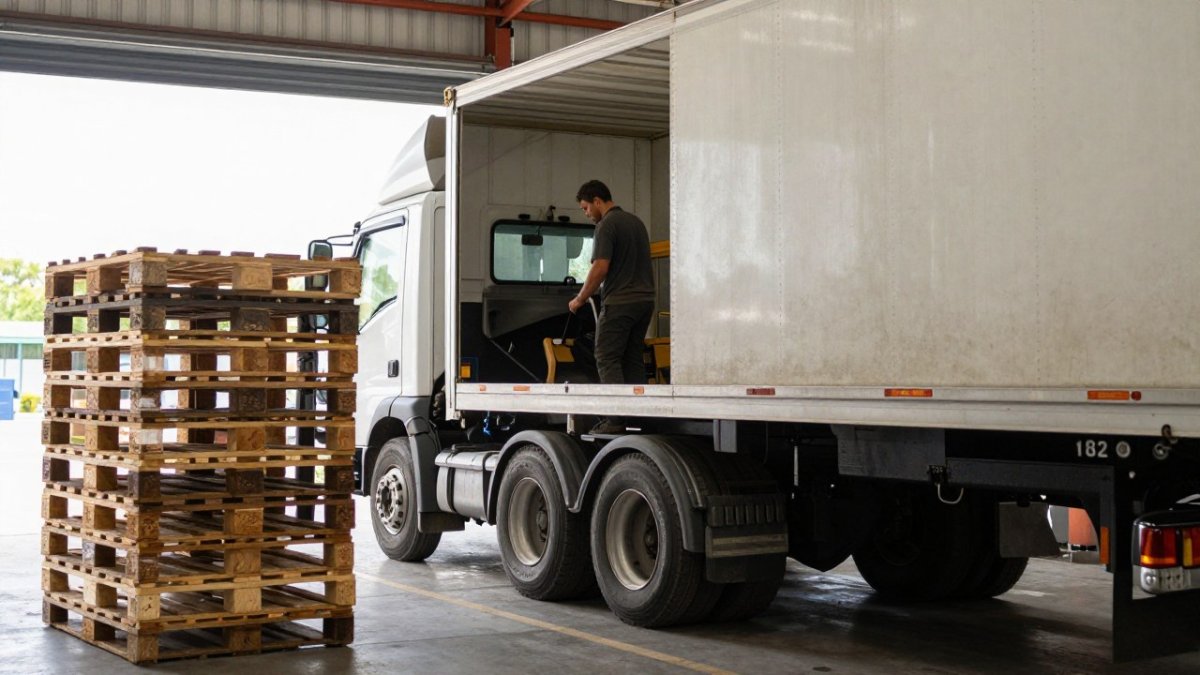
Check payload before anything else. Each truck has a maximum payload, and exceeding it creates a safety risk and a legal problem. Ask the carrier for the rated payload of the specific vehicle they will send, not the general class.
Consider the tray length as well. Pallets must sit within the tray without overhanging in a way that breaks load restraint rules. If a pallet overhangs the tray, the carrier needs to know before booking.
Tail-lift and hydraulic tailgate requirements
Many pallet loads cannot be unloaded by hand, so a tail-lift or hydraulic tailgate matters. A tail-lift lowers the load to ground level, saving a forklift at a site that has none.
If your delivery site is a kerbside address with no dock, ask for a tail-lift vehicle specifically. Drivers who arrive without one may be unable to unload, which costs time and often adds a return trip fee.
Forklift access and sites without forklifts
Forklift access determines whether the truck can unload at its destination. Where there is a forklift and a dock, a standard truck with a rear roller door is often enough.
Also check the approach. Narrow driveways, low overhead clearance and limited turning space can stop a larger vehicle from reaching the drop-off point. Describe site access in your booking so the carrier can send a vehicle that fits.
How to Verify a Carrier Before You Book
A carrier that looks reliable online may still miss pickups, lose freight or fail to answer the phone when a load is late. Verifying the operator before you commit protects your schedule, your goods and your customer relationships.
Confirm the legal and insurance basics
Start with the credentials that make a carrier accountable. Ask for the carrier's Australian Business Number (ABN) and confirm it is active on the Australian Business Register.
Insurance is the next filter. Ask for a certificate of currency for the relevant cover:
- Goods in transit cover, pays for your freight if it is lost or damaged in transit. Confirm the cover limit is at least the total value of your consignment, and check whether the policy excludes certain goods such as electronics, liquids or high-value items.
- Public liability cover, protects against damage to third-party property or injury at a delivery site.
- Motor vehicle or heavy vehicle insurance, confirms the vehicle itself is covered.
A certificate of currency is a snapshot, not a guarantee. Ask the carrier to confirm the policy is current and that your freight type is not excluded. If your load value exceeds the carrier's goods in transit limit, arrange separate transit insurance or negotiate a higher declared value.
Ask how load restraint is managed
Freight that shifts in transit is a common cause of damage and a safety breach. Load restraint is governed by heavy vehicle law, and the regulator publishes guidance on the performance standards (Load Restraint Guide). A reliable operator can explain how pallets are restrained, by straps, load bars, gates or shrink wrap, and what they do when a load arrives damaged.
Ask specifically:
- What restraint method do you use for pallets of this weight and height?
- Do you inspect loads before departure, and who signs off?
- What is your process if a pallet shifts or is damaged in transit?
A carrier who cannot answer these questions directly has not thought about them.
Test their communication and contingency planning
Breakdowns, traffic and weather happen. A dependable carrier tells you how they will communicate delays and whether they can send a replacement vehicle. Ask:
- Who is my point of contact on the day, and what is their direct number?
- How will you notify me if the pickup or delivery is running late?
- Do you have access to additional vehicles if the booked truck fails?
Carriers who answer these questions directly are the ones who perform best on the day. Carriers who deflect or promise vaguely leave you chasing information.
Check tracking, proof of delivery and claims
Reliability is measurable. Ask how the carrier tracks loads and what proof of delivery they provide. A signed proof of delivery, returned promptly, is your evidence if a pallet goes missing or arrives damaged. Ask how quickly they return PODs and whether they provide photo evidence at pickup and delivery.
Claims handling is the clearest test of a carrier's professionalism. Ask:
- What is your claims process for damaged or lost freight?
- What is the time limit for lodging a claim?
- How long does a typical claim take to resolve?
A carrier who cannot describe a claims process has never had to honour one.
Speak to recent references
Ask for two or three recent references with similar loads, same pallet count, similar weight and comparable route. You can also browse the freight load board to see the operators and drivers active on the platform. Speaking to a current customer tells you more than any listing or review. Ask how the carrier handled a delay or a problem, not just whether the delivery arrived.
Watch out: a carrier who cannot supply a single reference for similar work, or who supplies unreachable references, is a risk you should not take with a time-sensitive pallet load.
Pallet Transport Quotes: Comparing Like With Like
Quotes for pallet transport often look very different, even for the same job. Compare freight quotes online to gather multiple offers in one place. The gap usually comes from what each quote includes, not the headline price. Understanding how carriers build a quote lets you compare offers on the same basis and spot the one that is cheap for a reason.
What actually drives the price
Pallet freight pricing is not a single rate per pallet. Carriers build a quote from several components, and each one can vary between operators:
- Distance and route, local metro work is priced differently from regional and interstate runs. Interstate linehaul often uses a per-pallet rate plus a fuel levy, while local work may be priced hourly or per job.
- Pallet count and weight, most carriers price by the pallet, but heavy pallets may attract a weight surcharge once they exceed a threshold. Ask whether the rate assumes a maximum weight per pallet.
- Vehicle type, a tail-lift truck costs more to run than a standard rigid, and a semi-trailer costs more again. If your site needs a tail-lift, expect that to be reflected in the rate.
The comparison table to build before you call
Before requesting quotes, write down the same job specification for every carrier. A quote is only comparable if the underlying job is identical.
| Detail | What to specify | Why it changes the quote |
|---|---|---|
| Pickup and delivery addresses | Full street address, not just suburb | Distance and access drive the base rate |
| Pallet count | Total pallets, including any overhang | Sets the vehicle size and per-pallet rate |
| Weight per pallet | Loaded weight, not just goods | Triggers weight surcharges above thresholds |
| Dimensions | Length, width and height per pallet | Confirms fit and whether oversized rates apply |
| Tail-lift required | Yes or no at each end | Adds vehicle cost and time |
| Forklift available | Yes or no at each end | Determines unloading method and labour |
| Delivery window | Date, time and any appointment | After-hours or tight windows may attract surcharges |
| Waiting time allowance | Minutes included before charges apply | Waiting time is a common hidden extra |
| Insurance | Value of goods and required cover | May be included, extra or excluded |
Send this specification to every carrier and ask them to quote against it line by line. A carrier who quotes without asking about access, tail-lift or weight is guessing.
Reading the quote: what to check before you accept
When quotes arrive, compare them on these points rather than the total alone:
- Is the rate per pallet, per job or per hour? A per-hour rate can look cheap until waiting time or traffic adds hours.
- What is excluded? Tail-lift use, waiting time, re-delivery, tolls and fuel levies are the usual exclusions. Ask each carrier to state them separately.
- What is the waiting time allowance? Most carriers include a short free period, often 15 to 30 minutes, before waiting time is charged. Confirm the rate after that.
A quote far below the others often means something has been left out. Ask what is excluded before you accept it.
When vehicle hire beats carrier freight, and when it does not
For some shippers, hiring a truck and driver directly is cheaper than booking per-pallet freight.
| Option | Best for | Watch for |
|---|---|---|
| Per-pallet carrier freight | Small to medium consignments, one-off or irregular loads | Accessorial charges, limited control over timing |
| Dedicated vehicle hire | Full loads, multi-drop runs, regular routes | You manage the driver, fuel, tolls and compliance |
| Freight platform or load board | Comparing multiple carriers quickly, flexible volumes | Vetting carriers yourself, variable service levels |
Vehicle hire typically makes sense when you can fill the truck and control the route.
Pricing depends on quantity, distance, dates and the vehicle needed, so there are no fixed figures to quote here.
Watch out: a quote that bundles everything into one figure without a breakdown is hard to compare and harder to dispute.
Pallet Delivery Checklist Before Dispatch
Run through this checklist on the day before pickup. Most delivery problems come from details that were confirmed informally and never written down.
- Pallet count, weight and dimensions confirmed in writing
- Vehicle type matches payload and tray length
- Tail-lift requirement noted if there is no forklift at either end
Print the list and keep it with the load documents. A shared checklist also helps the warehouse team and the receiver know what to expect.
Tracking Your Pallet Delivery From Pickup to Drop-Off
Tracking tells you where the load is and whether it is on schedule.
Ask the carrier how they update you. Some provide live location, others give status messages at set points such as pickup, departure, and arrival.
Track the load at each stage:
- Pickup confirmed: Pallets loaded, count checked against your sheet
- In transit: Estimated arrival time shared, any delay flagged
- Arrival: Driver checks in with the receiver
- Delivery complete: Signed proof of delivery returned to you
Keep proof of delivery with your records. It is your evidence if a pallet goes missing or arrives damaged, and it settles disputes quickly.
Booking Your Next Pallet Load With NextLoad Australia
Once you have your load details, your vehicle requirement and a short list of verified carriers, you are ready to book. Request a pallet transport quote to get started right away.
Start with your load sheet so the carriers you contact can quote accurately. Check each carrier's references before you confirm. Keep your checklist and tracking plan in place from pickup to drop-off.
Frequently Asked Questions
How do I find a reliable truck for pallet delivery?
Start by confirming the carrier's vehicle type, capacity and insurance, then ask for references from businesses moving similar loads. Check whether the truck suits your pallet count, weight and site access, including whether a tail-lift is needed. Compare at least three quotes on the same basis, and confirm how the carrier handles pickup windows, delays and damaged goods before you book the load.
What type of truck is best for pallet delivery?
The right truck depends on how many pallets you are sending, their total weight and where they are going. Smaller loads often suit a light or medium truck, while larger runs may need a medium rigid or heavier vehicle. If the delivery site has no forklift, a truck with a tail-lift or hydraulic tailgate is usually required. Confirm the vehicle's payload before you book.
What should I check before booking a pallet transport carrier?
Check the carrier's licence and insurance, the vehicle's registration and payload, and whether the driver has experience with pallet loads. Ask how they secure loads and what their process is for late pickup or missed delivery. Request a written quote that states the included services, any extra charges and the pickup and delivery windows. Ask for a contact person who can answer questions during the job.
How can I compare pallet transport quotes?
Compare quotes only when they cover the same pallet count, weight, dimensions, pickup and delivery addresses, and any tail-lift or access requirements. Check whether fuel, tolls, waiting time and insurance are included. A lower price may leave out services you need, so list each inclusion next to the others. NextLoad Australia can provide current pricing and quotes on its website, as rates depend on quantity, dates and delivery details.